

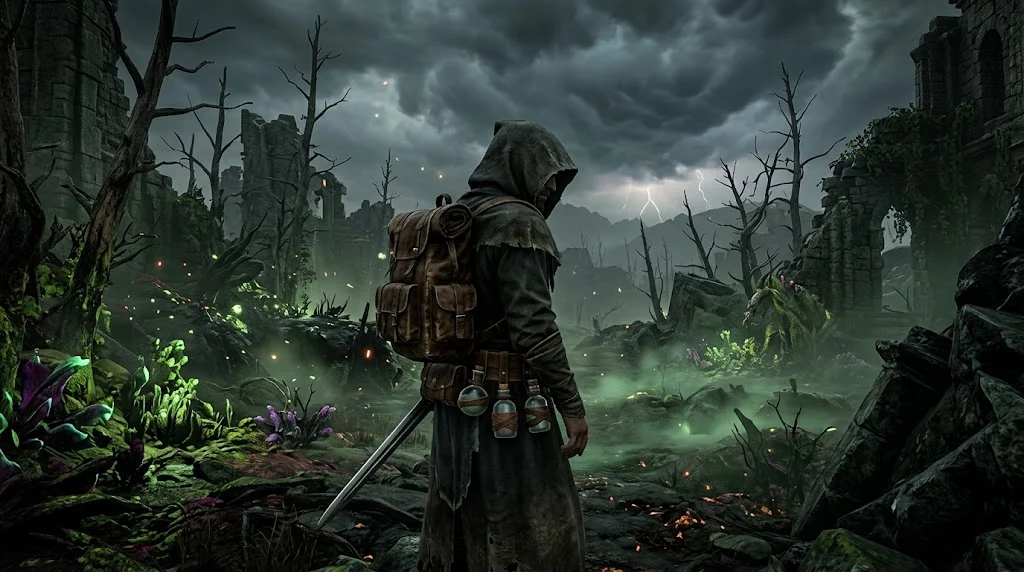
Starting your journey as the Warden in Mount Morbus feels deceptively simple until the harsh realities of the world set in. Many players enter the game expecting a conventional action role-playing adventure, only to hit an unforgiving wall of weapon degradation, aggressive corruption, and sudden permadeath loops. Searching for theserpentrogue competitive edge usually stems from this friction. Players want to know if there is a secret perk, an unlisted multiplayer build, or a game-breaking exploit that suddenly makes survival easy.
The truth is grounded in smart game design. The Serpent Rogue, developed by Sengi Games and published by Team17, is strictly a single-player dark fantasy experience. There are no PvP ladders, and you will not find an official skill called “Competitive Edge” in any menu. Instead, achieving theserpentrogue competitive edge means mastering the interconnected systems of the game: treating alchemy as a grammatical science, turning wildlife into productive tools, manipulating environmental consequences, and navigating deadly weather patterns. When you understand how these gears turn together, the game transforms from an overwhelming trial into an engaging, solvable puzzle.
| Game Attribute | Specification Details |
| Title | The Serpent Rogue |
| Developer / Publisher | Sengi Games / Team17 |
| Genre | Dark Fantasy Action-Adventure, Roguelike Alchemy Sandbox |
| Core Character | The Warden |
| Primary Advantage | Deep system mastery, potion formulation, and cause-and-effect planning |
| Multiplayer / PvP | None (Purely Single-Player Experience) |
What theserpentrogue competitive edge Actually Means
In traditional hack-and-slash games, overcoming an obstacle involves leveling up your character, dodging with frame-perfect precision, or finding a sword with higher raw damage. Try that here, and you will quickly burn through precious durability, lose your entire inventory, and find yourself trapped in a hostile wasteland.
Building theserpentrogue competitive edge means shifting your mindset from reactive combat to proactive preparation. The game is an ecological sandbox where every action creates an equal reaction. If you leave corpses scattered on the ground, ghouls spawn to feast on them. If you drop items loosely on your campsite floor, vermin arrive to steal your hard-earned materials. Gaining an advantage means anticipating these chain reactions before they occur. It is the tactical separation between wandering aimlessly into danger and entering an expedition with clear goals, calculated retreat routes, and the exact tools needed to clean up the aftermath.
The Alchemy Engine: Grammatical Brewing and Research
If you want to understand theserpentrogue competitive edge, you have to dissect the potion crafting system. Alchemy in this world is not a simple matter of throwing random plants into a pot and hoping for a positive status boost. It works like a constructed language, where every potion formula operates as a three-part grammatical sentence: Modifier, Value, and Attribute.
For instance, brewing an essence might combine an action like “Add” or “Remove,” paired with a numeric intensity like “2” or “5,” targeted at a specific attribute such as Vitality, Age, or Weight. If you combine these elements incorrectly, you can accidentally create a concoction that ages your character into frailty or heals the very monstrosity you are trying to defeat.
Experienced players build an edge early by honoring the research bench. When you find an unfamiliar ingredient, resist the urge to brew it blindly. Carry it to your laboratory table and invest the required number of samples to permanently record its properties in your formula book. Once an essence is registered, you eliminate guesswork entirely. You can craft targeted antidotes, high-yield healing drafts, and explosive offensive jars while sitting safely in your camp, long before setting foot inside corrupted territory.
Ecological Cause and Effect: Controlling the World Around You
One of the most remarkable features of the game is how Mount Morbus tracks your behavioral footprint. Most guides gloss over this mechanic, yet controlling your environmental impact is essential to securing theserpentrogue competitive edge.
The world operates on specific tipping points. When you defeat five enemies in a zone and fail to bury their remains, the air grows foul and flesh-eating ghouls begin to spawn in heavy patrols. If you carry a shovel and take thirty seconds to bury or burn those corpses, you keep the ambient danger low. Similarly, hoarding materials by dropping them in open piles around your central hub invites vermin infestations, while gathering too many living creatures in a cramped paddock summons towering Reapers that can decimate your base. Keeping your camp organized, utilizing secure storage, and cleaning up your battlefields prevents unforced difficulty spikes from ruining your progress.
Zone Timers, Corruption Storms, and Exploration Routes
Surviving the Wasteland requires strict discipline, and this is another area where theserpentrogue competitive edge separates successful expeditions from failed ones. Corrupted zones are not static dungeons; they are governed by cyclical, violent storms that periodically sweep the landscape, destroying structures, resetting resource nodes, and annihilating anyone caught outside shelter.
Smart exploration relies on a strict turn-back threshold. Always monitor the storm timer displayed on your screen. The moment that countdown dips below safe travel time, abandon whatever treasure chest you are eyeing and make your way to the exit. You can also exploit these storms intentionally: because a tempest completely replenishes gathering nodes and shuffles valuable items, returning to a recently cleansed zone immediately after a storm passes lets you farm rare reagents with maximum efficiency. If you find yourself in danger far from home, entering a shelter or returning to the world map allows you to bypass storm damage entirely.
Creature Taming and Companions: Building an Animal Workforce
Attempting to conquer Mount Morbus alone is an unnecessary handicap. Taming creatures provides a massive boost to theserpentrogue competitive edge, turning wild beasts into valuable companions that solve two of the game’s greatest challenges: combat survivability and strict inventory weight limits.
Every beast in the wild responds to particular food preferences. By offering the proper feed, or using an alchemical hunger potion to force instant appetite, you can recruit chickens, dogs, and powerful forest creatures to your side. Once tamed, companions can carry hundreds of pounds of mined ore and gathered herbs, effectively serving as pack mules. When your expedition finishes, you can send these creatures back to the Abandoned House ahead of you, ensuring your heavy spoils arrive safely without weighing down your stamina during the journey home.
Shapeshifting and Transformation Mechanics
Beyond mixing drafts for health and status effects, high-level play relies heavily on physical transformation. Drinking shapeshifting mixtures allows the Warden to adopt the physical characteristics and immunities of other species, providing another layer of theserpentrogue competitive edge.
Transforming into specific animal forms changes how the environment and its inhabitants perceive you. Hostile beasts that would normally attack your human form on sight will ignore you when you match their species, allowing you to bypass deadly patrol routes without swinging a weapon. Certain forms also allow you to squeeze through narrow crevices to discover hidden caches, or grant natural resistance against poisonous swamps. Using transformation turns dangerous, high-risk encounters into quiet, bloodless recon runs.
Combat Strategy and Weapon Preservation
Direct combat in Mount Morbus should always be your secondary option, not your opening move. Weapons in this game have low durability pools and shatter quickly under sustained use. Gaining theserpentrogue competitive edge means treating direct melee trades as an absolute last resort.
Before entering an arena with a hostile creature, examine its behavior and affinities. Throwing a debuff jar from outside enemy detection range can weaken its resistances, strip its offensive power, or induce sleep before the real skirmish even begins. If you must engage in physical combat, let your tamed companions take initial aggression so you can land targeted strikes on the creature’s flanks without depleting your primary equipment. By prioritizing utility and preparation, you save scrap metal, avoid costly repairs, and keep your primary arsenal intact for mandatory boss encounters.
Managing Death: The Restless State and Recovery
Even careful alchemists make mistakes, but dying does not have to mean abandoning your save file. Understanding how to handle defeat is a core component of theserpentrogue competitive edge.
When your physical body falls in a hostile zone, you awaken as a skeletal ghost, entering what the game calls the Restless state. During this phase, you are fragile and your original satchel remains dropped at the spot of your demise. Panicking during this recovery phase is where most players lose everything. Instead of charging back into the fray, use your spectral state to quietly scout enemy positions. Move along the perimeter of the zone, avoid wandering patrols, recover your dropped gear, and retreat straight back to a safe sanctuary. Taking a calm, stealthy approach to your recovery run ensures that a momentary blunder does not wipe out hours of gathering.
5 Practical Habits for a Flawless Run
To consistently maintain theserpentrogue competitive edge across your entire playthrough, incorporate these five operational habits into every gaming session:
-
Establish Camp Chest Networks Early: Never leave materials on the ground where vermin can reach them. Maximize your shared storage chests inside the Abandoned House so you always have a clean, orderly repository for incoming loot.
-
Always Pack a Shovel: Treat your shovel with the same importance as your laboratory equipment. Use it to dig up valuable roots, bury enemy remains to prevent ghoul infestations, and keep the regional threat level manageable.
-
Carry Instant Escape Potions: Keep an emergency draught in your quick-slot bar at all times, whether it is a high-potency invisibility mix, a rapid-healing elixir, or a form-altering brew that lets you disengage from unexpected fights.
-
Respect the Storm Timer: Never let greed override caution. When the sky darkens and the storm warning appears, drop non-essential tasks and immediately begin your extraction to safe ground.
-
Batch Your Experiments: Do not consume single, isolated reagents in the field. Wait until you have returned to your central laboratory with enough duplicate ingredients to satisfy the research threshold in one focused session.
FAQs
Is there an official Competitive Edge perk in The Serpent Rogue?
No. There is no official perk, skill tree node, or item called “Competitive Edge.” The term is used by the gaming community to describe advanced system mastery, efficient alchemy research, and intelligent ecological management.
Is The Serpent Rogue a multiplayer or competitive game?
No. The game is purely a single-player sandbox adventure. Your competition is not other human players, but the hostile environment, expanding corruption, dynamic weather patterns, and the consequences of your own choices.
How do you fix failed potion experiments?
Failed potions occur when you pair conflicting modifiers and attributes, or when you use unresearched reagents. To fix this, always take raw ingredients to your laboratory table first and complete their research requirements to unlock verified recipes.
Can you stop weapons from breaking permanently?
Weapons suffer from continuous durability loss during combat and will eventually break. You can mitigate this by relying on throwables, leveraging companion attacks, and using offensive potions so your weapons are only drawn when necessary.








Leave a Reply